There is a moment I suspect many adult children of difficult mothers will recognize. Someone nearby goes quiet. A partner answers in one word where there would usually be ten, or a colleague who normally jokes around walks past with a short nod, and although nothing has actually happened between you, a familiar question is already running in the background: what did I do?
The silent treatment by a narcissistic mother can teach a child that question so early and so thoroughly that it still shows up decades later, long before there is any reason for it. I can’t tell you where you picked up the habit of searching yourself first, but I can describe where I picked up mine, because for years I didn’t recognize it as a habit at all. I thought I was simply paying attention, the way anyone does when the mood in a room changes.
When the Silent Treatment Was the Punishment
In the house I grew up in, silence was a punishment in its own right, and my mother could keep it up for a long time. She would ignore me for days, sometimes for weeks. Daily life went on around it in a strangely ordinary way. There was food on the table and the household ran as usual, but for her I was no longer part of it. She walked past me without a look or a word, and if something about me had to be discussed, she discussed it with my father while I sat right there, talking about me as if I were somewhere else. “He’ll never learn.” I heard every word, and none of them were meant for me to answer.
Anyone who pictures the silent treatment as a quiet household has never lived inside one. There were loud sighs, cupboards shutting harder than usual, dishes landing on the counter with real force. The only thing that had disappeared was anything said to me.
For a child, a parent’s silence is anything but neutral, and in one respect it cut deeper than the shouting ever did. An outburst at least came attached to a reason, or to something I could mistake for one. The silence told me that I had done something wrong and refused to tell me what. The only thing I could be certain of was that the fault, whatever it was, was mine.
Searching for My Mistake
So I spent those days and weeks searching for it. I went back through everything I had recently said and done, replaying conversations and small decisions, convinced that a punishment this long had to have a cause and that, since nobody would name it, I had to find it myself.
The search didn’t stay inside my head, and one memory from those periods has stayed with me more stubbornly than the louder ones. I often set the table for the three of us, and when I did, I arranged my parents’ plates and cutlery carefully at their places, exactly as it should be done, and then simply dropped my own onto the table without any care at all. I did that deliberately, because I was convinced that a boy who had done something bad didn’t deserve a properly set place. Nobody had asked this of me. By that point, I was continuing the punishment on my own.
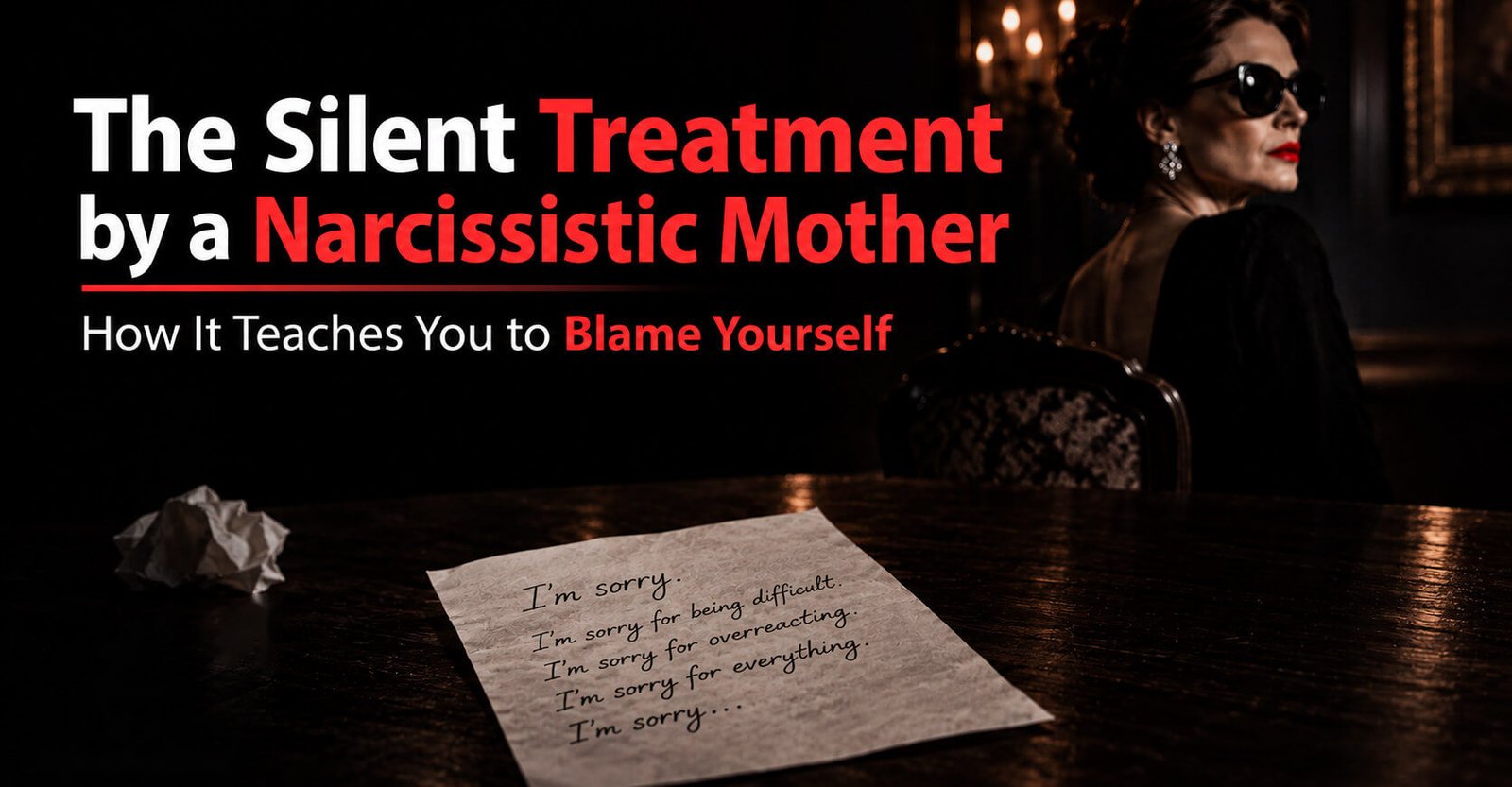
I tried apologizing in writing, too. More than once I gave my mother letters of apology, and because I didn’t know what I was apologizing for, I apologized across the board: I admitted that I had behaved badly, assured her that I understood it, and promised to finally become a good son. I kept hoping one of those letters would soften her enough to let me back in, and as far as I remember, not one of them was ever answered. Looking back, the letters themselves trouble me less than how normal it felt to put a full confession on paper without being able to name a single thing I had actually done.
The Rule a Child Learns
What never occurred to me, in all that searching, was that my mother might simply be treating me unfairly. That conclusion wasn’t available to a child in my position, and today I think I understand why. I depended on her for everything that holds a child’s world together, and admitting that she was unpredictable would have meant admitting that nothing around me was solid. Blaming myself was, strangely, the more bearable option, because a fault of my own was at least something I could work on. I could always search harder and apologize earlier. Self-blame gave me something to do, and having something to do felt like having at least some control.
Years of repetition turned that into a reflex. At some point I no longer decided to look for my mistake; I just looked, the moment anyone around me seemed displeased.
Researchers call the experience of being ignored or excluded ostracism. A review in Nature Reviews Psychology describes how exclusion can threaten basic psychological needs and affect thoughts and behavior, and earlier research by Kipling Williams connects it to belonging, self-esteem, control, and the feeling that you matter at all. I read this work with some caution, because it concerns ostracism in general, studied mostly in adults over short episodes, and it cannot prove what caused my particular adult reactions. What it does support is a more modest point: being treated as though you don’t exist is hard on anyone, and a child who goes through it again and again, with the one person he depends on most, doesn’t come out of it unchanged.
In my eBook, Leaving Hell, I describe how emotional abuse affected different parts of my adult life. One of the things I carried out of that house was the belief that whenever someone around me seemed unhappy, I must have done something wrong, and it was my responsibility to find out why.
How the Rule Fires Decades Later
What stayed with me into adulthood was the habit of looking for my own mistake whenever someone seemed quiet or upset. I learned it during those years of being ignored by my mother, and even now the question can appear before I’ve stopped to consider whether the other person’s mood has anything to do with me.
At work, a short message from a manager can start the old search before I’ve even finished reading it. Perhaps I misunderstood the task, perhaps there’s a mistake in my report, perhaps someone has finally noticed that I’m not as capable as they assumed. Nothing in the message says any of that, and I start looking for my offense anyway.
It happens at home as well, which is harder to admit. My wife can be quiet for the most ordinary reasons, because she’s tired or because her thoughts are somewhere that has nothing to do with me, and before I’ve asked her a single question, the old ones may already be lining up inside me. Whether I did something, whether she’s upset with me, and underneath those, the oldest one: does she still love me? She has never given me a reason for any of this. She doesn’t punish with silence, she doesn’t withdraw warmth to make a point, and she has never made me guess my way back into her good graces. The reaction belongs entirely to my history. She just happens to be nearby when a reaction starts that is much older than our marriage.
That is the mechanism this article is really about. A mood shifts, a room goes quiet, somebody sighs, and the conclusion is there before any facts are: I must have done something wrong.
Psychology offers a concept that helps describe this kind of reaction. In a 1996 study, Geraldine Downey and Scott Feldman described rejection sensitivity, the tendency to anxiously expect rejection and to read ambiguous behavior as rejection. I mention it as a framework, not as proof. The research doesn’t establish what caused my own reactions, and I’m not diagnosing myself with anything. It simply shows that reading harmless signals, like a sudden silence, as rejection is a pattern psychologists have studied, not something I invented.
That habit of blaming myself didn’t exist in isolation. It was part of a wider pattern of guilt, self-doubt, and fear of conflict that I’ve written about in my article on the consequences of growing up with an emotionally abusive mother.
Not All Silence Is Punishment
Silence by itself is not abuse, and I don’t want this article to suggest otherwise. People get tired, people need space, and people go quiet because their heads are full of something that has nothing to do with anyone else in the room. A partner who says they need a day to think and will talk tomorrow isn’t giving you the silent treatment. They’re doing the opposite, telling you what is happening and when it will end.
What set my mother’s silence apart wasn’t the quiet itself but what the silence was for. It came without explanation, it had no end date, and underneath it sat an unspoken condition: do what I want, and you may be allowed to exist again. Clinicians draw a similar line. In a Cleveland Clinic article on the silent treatment, psychologist Kia-Rai Prewitt points to intent, separating a person who shuts down because they’re overwhelmed from a person who uses silence to control or punish, and notes that when parents use silence as a consequence, children experience it as conditional love.
The distinction cuts the other way too. Not everyone who grew up with punitive silence ends up with my reactions, and more importantly, the quiet person in front of me today is not my mother. When my wife goes quiet, I’m not back at that childhood table, however loudly an old part of me insists that I am. Sometimes a tired person is simply tired, and it took me an embarrassingly long time to accept how often that is the entire story.
There is also the silence that comes with chosen distance. I’ve written about why I eventually went no contact with my mother, and I know that from the outside it can look like the same move. It isn’t. Protecting yourself from ongoing harm is not the same as withholding attention until somebody obeys.
The Pause Between the Signal and the Conclusion
I would like to report that the question stopped coming, but honesty is supposed to be the point of this website, so I won’t. The question still comes. What has changed over the years is how much authority I give it. The sigh still registers, the quiet still registers, and the old search still tries to start, but I’ve learned that there is a pause between the signal and the conclusion, and that pause is mine to use. In it, I can sort what I actually know from what I’m assuming, and ask myself whether anything has happened at all or whether an old rule has simply been switched on by a new silence.
The other skill took me longer: asking instead of assuming. As a boy I read people rather than questioning them, because in our house a direct question could get you into trouble all by itself. As an adult I’ve had to practice the reverse, checking whether someone is actually annoyed with me instead of quietly building the whole explanation on my own. The answer isn’t always reassuring, and sometimes it really is yes, I’m annoyed. In a normal relationship, though, that turns out to be survivable. Nobody disappears for weeks, and nobody talks about you in the third person at the dinner table.
To be fair about it: my history explains these reactions, but it doesn’t make my fear anyone else’s job to manage, and it gives me no right to treat a tired person as if they had accused me of something. I didn’t choose the rule, but what I do with it as a grown man is my responsibility.
The silence taught me to apologize for things I couldn’t name. These days, when a room goes quiet around me, I try to wait before deciding what it means, because most of the time someone is just tired, or busy in their own head with something that has nothing to do with me. I don’t manage it every time. But I no longer write the apology first.
Read More in Leaving Hell
The silent treatment was only one part of what I grew up with. In Leaving Hell: Escaping the Toxic Chains of a Narcissistic Mother, I share more of my story, how years of control, guilt, and self-doubt affected my adult life, and what changed after I finally left.
